A Beginner-Friendly Drunkard’s Path Tutorial
If the words curved piecing make your shoulders tense up, you are not alone. Curves have a reputation for being fussy, inaccurate, and just a little bit intimidating. But here’s the truth: curves aren’t hard—they’re just different.
The Drunkard’s Path block is one of the most classic curved quilt blocks, and it’s the perfect place to start. With a few simple techniques (and a mindset shift!), you can sew smooth, accurate curves without stress.
This tutorial walks you through every step—from cutting to pressing—so you can sew curves with confidence and actually enjoy the process.
What Is a Drunkard’s Path Block?
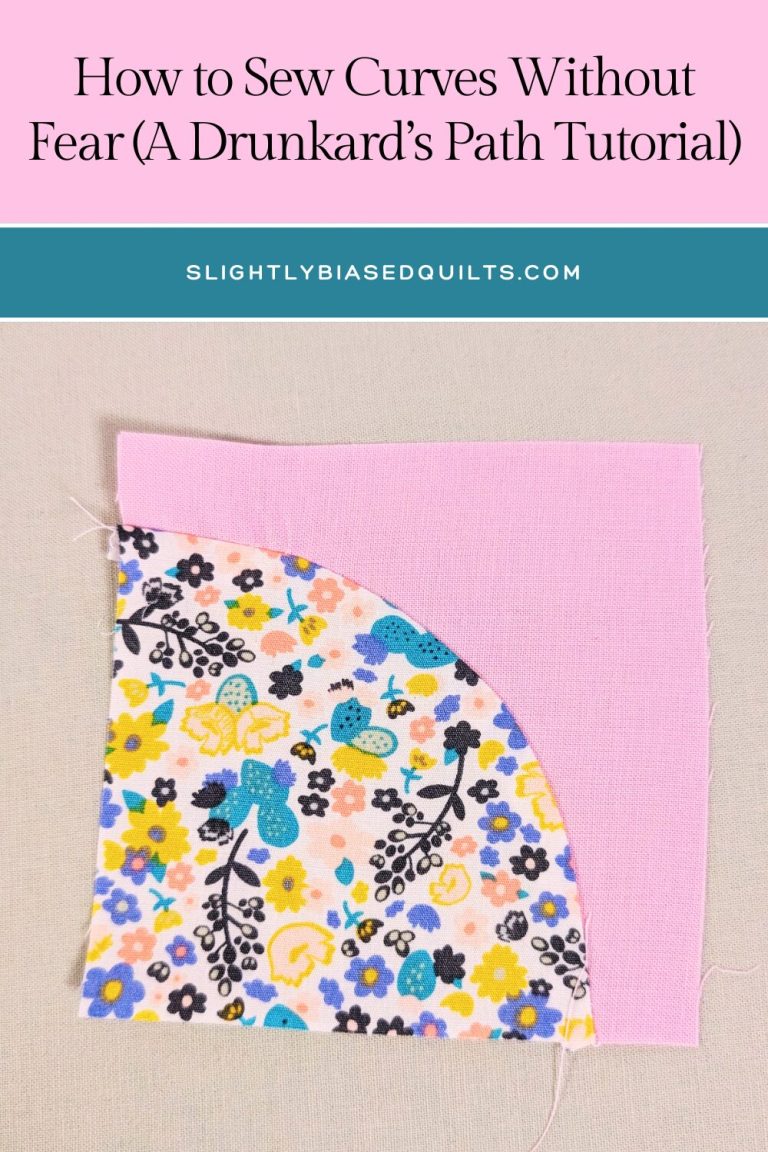
The Drunkard’s Path block is made from two curved pieces:
- One convex curve (the “pie” shape)
- One concave curve (the “L” shape)
When sewn together, they create a quarter circle. Rotate and combine them in different ways, and you can make everything from traditional layouts to bold, modern designs.
Tools & Supplies You’ll Need
- Drunkard’s Path template or acrylic ruler
- Rotary cutter and mat
- Quilting cotton (starch optional but helpful)
- Sewing machine
- Neutral thread
- Pins (optional—yes, really!)
- Iron and pressing surface
Helpful tip:
If this is your first time sewing curves, choose solid or low-volume fabric. Busy prints can hide what’s happening along the curve and make learning harder.
Step 1: Cut Accurately (This Matters More Than You Think)
Accurate cutting is the foundation of successful curved piecing.
- Follow the template or ruler instructions exactly.
- Make sure your fabric is flat and smooth before cutting.
- Don’t rush—clean cuts make sewing easier later.
If you like, lightly starch your fabric before cutting. A little extra stability can make curves feel much more manageable.
Step 2: Find and Mark the Centers
This step is simple—but incredibly helpful.
- Fold each curved piece in half and lightly finger press to find the center.
- Mark the center with a pin or small crease.
Matching the centers helps distribute the curve evenly and prevents stretching or distortion.
Step 3: Align the Curves (Pinning Optional!)
Place the pieces right sides together, matching the center points first.
- Pin at the center.
- Add one or two pins toward each end if that feels more comfortable.
Step 4: Sew Slowly and Let the Fabric Do the Work
This is the most important part: do not stretch the fabric.
- Sew with a normal stitch length (2.0–2.2 works well).
- Keep the concave piece on top so you can gently ease it to match the curve below.
- Stop with the needle down if you need to adjust.
Go slow. Curves reward patience, not speed.
Step 5: Press (Don’t Iron!)
Pressing curved seams correctly makes all the difference.
- Press the seam as sewn first to set the stitches.
- Then press the seam toward the concave piece.
- Avoid dragging the iron—lift and press to prevent distortion.
If needed, use a tailor’s clapper or let the fabric cool before moving it. Curves like to settle before being handled.
Step 6: Square Up (If Needed)
Once your block is sewn and pressed:
- Check that it lays flat.
- Trim or square up according to your pattern.
Minor imperfections are normal—especially while learning. Curves are forgiving, and small variations usually disappear in the finished quilt.
Common Curve-Sewing Mistakes (and How to Avoid Them)
Wavy seams:
→ Caused by stretching. Slow down and ease the fabric gently.
Points not lining up:
→ Make sure center points are matched before sewing.
Block doesn’t lie flat:
→ Check your pressing and avoid pulling the fabric while sewing.
Remember: every curved seam builds muscle memory. It gets easier with each one.
Practice Ideas to Build Confidence
- Make a few test blocks with scrap fabric
- Try a scrappy Drunkard’s Path layout
- Use curves in a pillow or small project before a full quilt
Curves don’t need to be perfect to be beautiful—especially in modern quilts where movement and softness are part of the charm.
Curved piecing isn’t something to fear—it’s a skill you can absolutely learn. The Drunkard’s Path block is a gentle introduction that teaches you how fabric behaves, how to ease curves, and how to trust your hands at the machine.
So take a deep breath, slow down, and give curves a try. You might just find they become one of your favorite things to sew.
Happy stitching—and welcome to the curve-loving side of quilting. 🧵✨