There’s something especially satisfying about finishing a quilt—until you remember the part where you still have to wrestle it through your sewing machine.
If you’ve ever felt that moment of hesitation staring at a fully basted quilt, wondering how you’re going to manage all that bulk, let me introduce you to a method that feels equal parts practical and empowering: Quilt-as-You-Go.
It’s one of those techniques that quietly changes the way you think about quilting—making the process feel more approachable, more flexible, and honestly, a little more enjoyable.
What Is Quilt-as-You-Go?
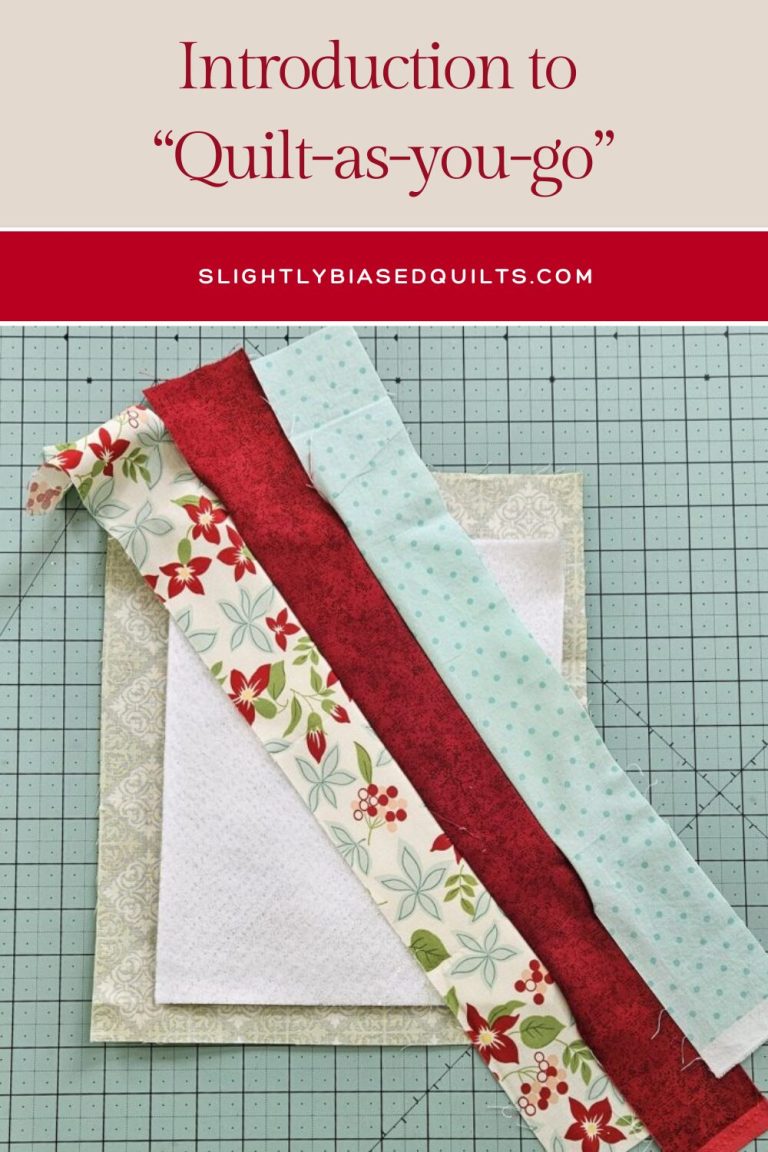
At its core, Quilt-as-You-Go (often shortened to QAYG) is exactly what it sounds like: you quilt your project in smaller sections before joining them together.
Instead of:
- Piecing your entire quilt top
- Making a quilt sandwich
- Quilting the whole thing at once
You:
- Piece a block (or section)
- Quilt it immediately with batting and backing
- Join the finished sections into a completed quilt
It breaks the process into manageable, bite-sized steps—perfect for busy seasons or smaller sewing setups.
Why Quilters Love It
Once you try QAYG, it’s easy to see why so many quilters keep coming back to it.
🧵 It’s Easier on Your Machine (and Your Shoulders)
Working with smaller sections means less bulk, less drag, and far less wrestling under the needle.
🪡 It Fits Into Real Life
You can finish one block at a time—ideal for those in-between moments when you don’t have hours to dedicate to a full quilting session.
✨ It Feels Like Constant Progress
Each block is fully quilted as you go, which means you’re not saving all the “hard part” for the end.
Different Ways to Quilt-as-You-Go
There’s no single “right” way to approach QAYG, which makes it especially fun to explore.
Traditional Block-by-Block
Each block is pieced, layered, quilted, and then joined with sashing or joining strips.
- Great for beginners
- Clean, structured finish
- Easy to keep everything aligned
Joining Without Sashing
For a more seamless look, blocks can be joined using techniques that connect batting and backing as you go.
- Slightly more advanced
- Creates a more traditional quilt appearance
- Worth it if you prefer a continuous design
Sectional Quilting
Instead of individual blocks, you can divide your quilt into larger sections (quarters, rows, etc.).
- Ideal for bigger quilts
- Allows for more cohesive quilting designs within sections
Fabrics and Batting Considerations
Because you’re working in sections, a few thoughtful choices can make the process smoother:
- Low-loft batting is easier to manage when joining pieces
- Consistent backing fabrics help everything line up cleanly
- Pressing carefully at each stage makes a big difference in your final result
And if you love working with wovens (which I know you do), they can add a beautiful texture—just be mindful of stability and consider a slightly denser quilting pattern.
Quilting Designs That Shine in QAYG
One of the biggest questions with Quilt-as-You-Go is how to approach the quilting itself.
Since you’re working block by block, designs that don’t rely on perfectly continuous lines tend to work best:
- Straight-line quilting
- Crosshatch grids
- Organic waves or gentle curves
- Simple motifs repeated in each block
That said, a little variation between blocks can add charm—it doesn’t have to be perfectly uniform.
A Perfect Match for Certain Projects
Quilt-as-You-Go is especially well-suited for:
- Baby quilts
- Throw quilts
- Table runners and placemats
- Block-of-the-month projects (hello, Tulip BOM 👀)
It’s also a wonderful method if you’re quilting in a smaller space or on a domestic machine.
A Gentle Learning Curve
Like any technique, QAYG has its quirks:
- Joining seams can feel a bit unfamiliar at first
- You’ll want to be precise with seam allowances
- Planning your quilting design ahead of time helps
But once it clicks, it opens up so many possibilities—and removes one of the biggest barriers many quilters face.
A Different Way to Experience Quilting
Quilt-as-You-Go isn’t just a technique—it’s a shift in rhythm.
It invites you to slow down, to finish as you go, and to enjoy each step of the process instead of saving everything for the end. There’s something deeply satisfying about stacking up completed, quilted blocks—each one a small finish in its own right.
And by the time you join that final section together?
You’re not just finishing a quilt—you’ve been finishing it all along.